Published Mental Steps for different moments, states, and destinations.
When your mind loops, freezes, overloads, waits, wanders, or simply cannot begin, pick the closest situation and follow the steps.
Some Mental Steps use MINDBEBOP apps.
Some use ordinary real-world actions.
Some combine both.
You do not need to understand the whole MINDBEBOP system first.
Start with the moment you are in.
How to Use This Library
Do not read everything.
Find the situation closest to what is happening now and try the Mental Steps that fit it.
MindEntry
can hold a sequence for you so you do not have to remember what comes next.
Some Mental Steps are fixed.
Others are Stateful Mental Steps that can adapt while you move.
Simple version:
Find your moment.
Take the next step.
Continue only as far as you need.
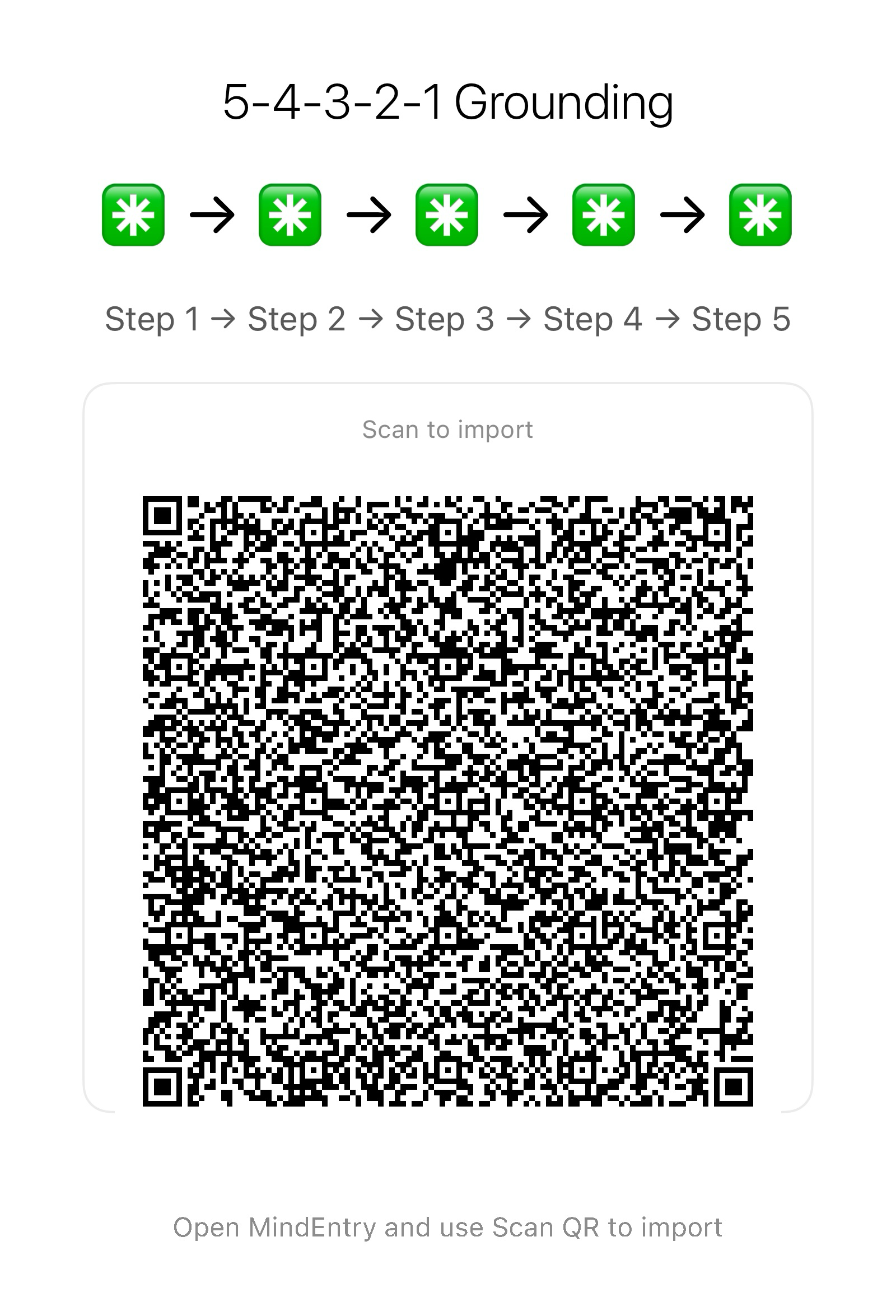
5-4-3-2-1 Grounding
The Situation:
Your mind feels overloaded or stuck inside itself, and you want to bring attention back to what is physically around you.
The 5-4-3-2-1 grounding method is already a known sensory exercise.
Running it through MindEntry
means you do not have to remember the sequence.
Step 1:
Acknowledge 5 things you can see around you.
Scan your physical environment and let your eyes rest on each object one by one.
Step 2:
Acknowledge 4 things you can physically touch.
Notice the texture of your clothing, desk, floor, or an object in your hand.
Step 3:
Acknowledge 3 things you can hear.
Listen for background sounds, a distant car, an appliance, or your own breath.
Step 4:
Acknowledge 2 things you can smell.
Notice subtle scents around you.
Step 5:
Acknowledge 1 thing you can taste.
Notice the current taste in your mouth or take a sip of water.
How it works:
The method redirects attention toward immediate sensory information.
MindEntry simply removes the extra burden of remembering what comes next.
Take these Mental Steps in MindEntry:
Import the sequence into MindEntry.
One screen, one step, no sequence to remember.
Method 1: Scan to Import (Use MindEntry's QR code reader. Currently Camera app is not supported.)
Method 2: Copy & Paste Code into MindEntry
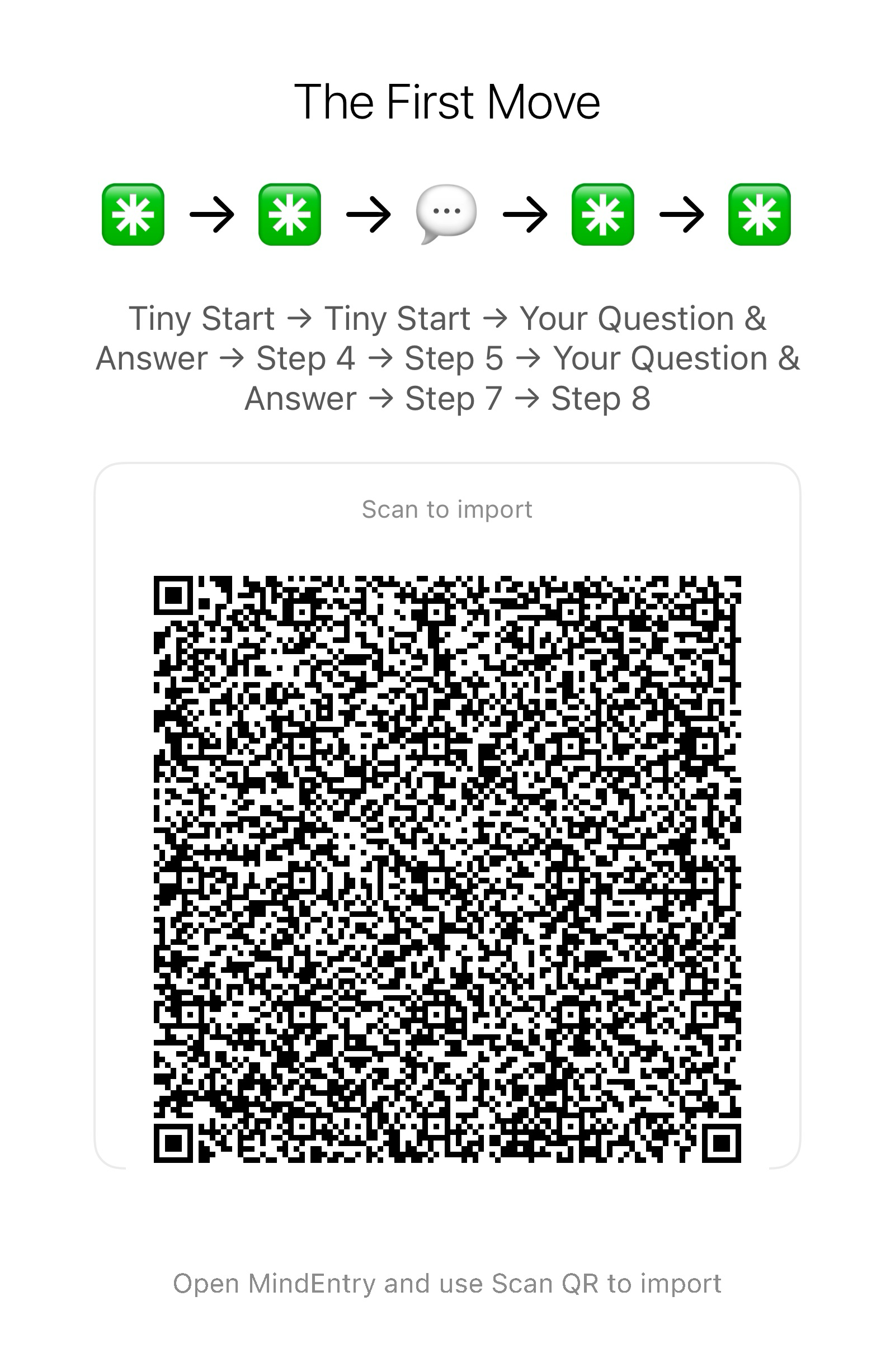
The First Move
The Situation:
You know what needs to be done, but you cannot begin.
The task feels too large, too complicated, or too heavy.
Instead of asking you to solve the whole task,
these Stateful Mental Steps reduce the distance of the next move.
Tiny Start:
Put both feet firmly on the floor.
This is not the task.
This is only the first sign of motion.
[Your Question & Answer]
What are you avoiding right now?
Example answer:
Write the report
Step 1:
Ignore every other task, project, obligation, and distraction.
For the next few moments, only this matters:
Write the report.
Step 2:
Move one step closer to:
Write the report.
Do not start the whole task yet.
Simply make it easier to begin.
Examples:
• Open the related file
• Open the related app
• Walk to the place where it happens
• Put the needed object in front of you
[Your Question & Answer]
What is the smallest visible action you can take right now?
Example answer:
Open the document
Step 3:
Do only this:
Open the document.
Step 4:
Once it is done, stop.
You have already begun.
Step 5:
If continuing feels easy, continue.
If not, stop.
The Mental Steps have already done their job.
How it works:
A stuck mind can try to solve the entire mountain before taking the first step.
These Mental Steps remove that requirement.
Tiny Start creates movement.
The first question creates focus.
The second creates a visible entry point.
Why this is Stateful:
The structure can work with different situations.
Today it might be “Write the report.”
Tomorrow it might be “Clean the room.”
The structure stays available while the current situation changes.
Take these Mental Steps in MindEntry:
Import the sequence into MindEntry.
One screen, one step, no sequence to remember.
Method 1: Scan to Import (Use MindEntry's QR code reader. Currently Camera app is not supported.)
Method 2: Copy & Paste Code into MindEntry
Don't Know Where to Start?
The Situation:
Your thoughts are looping, you feel overwhelmed, and you are not sure what to do with them.
MindFlipOut:
If a thought feels loud and specific, write it down as it is.
Then look at it again from a lighter angle.
MindZoneOut:
If you feel tense, restless, or flooded, start a short Zone session.
Do nothing for a moment.
Action:
Close the app when finished.
You do not need to do anything else.
Why?
Sometimes the useful next move is to work with the thought.
Sometimes it is to stop feeding it.
Start with whichever feels closer to what is happening now.
The Morning “Inner Argument” Kill-Switch
The Situation:
You are already simulating an argument with someone before the interaction has even happened.
MindFlipOut:
Take the heavy thought and rewrite it from a more workable angle.
MindShoutOut:
Schedule the useful thought for the time it will actually be needed.
Action:
Do something physical that marks the transition into the day.
Why?
The thought does not have to stay active all morning simply because it may become relevant later.
Midnight Cravings & False Hunger
The Situation:
You want a snack, but you suspect the urge is more about stimulation than hunger.
MindFlipOut:
Write the urge down and look at it again from another angle.
Action:
Change your immediate sensory context.
Stand up, drink water, or move away from the food for a moment.
Rest:
If you were already trying to sleep, return to bed.
Why?
A small interruption can create enough distance to decide what you actually want to do next.
Waiting for a Reply
The Situation:
You keep checking your phone because a message or email has not been answered.
MindShoutOut:
Create a later check-in such as “Check for reply at 6 PM.”
MindZoneOut:
Take a short Zone session before returning to something else.
Action:
Put the phone somewhere you are not automatically reaching for it.
Why?
The waiting can be given a future moment instead of remaining mentally active right now.
The Bedtime “Cringe Memory” Loop
The Situation:
An old mistake or embarrassing moment appears just when you are trying to sleep.
MindFlipOut:
Capture the thought and look at it again from another perspective.
MindEaseOut:
If you no longer need to keep working with it, release it.
MindZoneOut:
Use a short blank session before returning to sleep.
Why?
Not every memory that appears at night needs another round of analysis.
Post-Work Self-Criticism
The Situation:
The day is over and your mind is still evaluating everything you did or did not accomplish.
MindFlipOut:
Capture the harshest thought and look at it again from another angle.
MindZoneOut:
Give yourself a short period with no new input.
MindShoutOut:
If one thing genuinely needs tomorrow, give it tomorrow.
Why?
The end of the workday does not have to become another work session inside your head.
The Social Media Comparison Trap
The Situation:
You see someone else's life or success and suddenly feel behind.
MindFlipOut:
Capture the comparison and look at what assumption is hiding inside it.
MindEaseOut:
Release what you do not need to keep carrying.
Action:
Put down the phone and notice something physically present around you.
Why?
The goal is not to win the comparison.
It is to return to your own reality.
Pre-Presentation Panic
The Situation:
A meeting, presentation, or speech is approaching and your mind keeps rehearsing what could go wrong.
MindZoneOut:
Take a short Zone session.
MindFlipOut:
Write one thought only and look at it from a more workable perspective.
Action:
When the time comes, enter the situation rather than continuing the rehearsal.
Why?
At some point the useful next step is no longer more preparation.
It is entering the real situation.
Swallowing Your Anger
The Situation:
A conflict has ended externally, but it is continuing internally.
MindShoutOut:
Capture what is still active without needing to send it to anyone.
MindFlipOut:
When you are ready, shift attention from replaying the argument toward what you want to do next.
MindEaseOut:
Release what no longer needs to stay active.
Why?
The external conversation may be over while the internal one is still running.
Overwhelming “Vague Future” Anxiety
The Situation:
Your mind is trying to solve a future problem that cannot be solved right now.
MindShoutOut:
Give the concern a specific future review time.
MindFlipOut:
Look again at the thought you are carrying.
MindZoneOut:
Take a short blank session before returning to the present.
Why?
A future concern can remain important without requiring continuous attention.
The “Unproductive Holiday” Guilt
The Situation:
You have time off but cannot stop thinking about what you should be doing.
MindShoutOut:
Give genuinely actionable items a future moment.
MindEaseOut:
Release the thought that resting itself needs to be justified.
Action:
Do something sensory and present: cook, walk, garden, listen, or simply sit outside.
Why?
Your day off does not need to become another invisible task list.
The Early Sour Reset
The Situation:
A small irritating or sticky thought is beginning to gather momentum.
Action:
If appropriate for you, use a strong but ordinary sensory cue such as a sour taste.
MindFlipOut:
Capture the thought exactly as it appeared.
MindEaseOut:
If you do not need to keep working with it, release it.
Why?
The aim is simply to interrupt the developing loop early and change what happens next.
The Compulsive Check Interrupt
The Situation:
You feel the urge to check messages, email, analytics, or notifications again even though you just checked.
Pause:
Do not check immediately.
Notice the urge for a few seconds first.
MindFlipOut:
Capture the thought behind the urge.
MindShoutOut:
If something genuinely needs checking later, give it a later check-in time.
MindZoneOut:
Take a short Zone session without checking.
Why?
The urge and the action do not have to happen at the same moment.
The Dopamine Detox
The Situation:
You keep reaching for scrolling, checking, or refreshing even though you want to stop for a while.
MindShoutOut:
Capture the urge and give it a later moment if you actually want to revisit it.
MindBackOut:
If useful, temporarily remove access to the main escape app.
MindFlipOut:
Look at the thought that makes checking feel necessary.
MindZoneOut:
Spend a few minutes without replacing the stimulation with more stimulation.
Why?
Sometimes the difficult part is not deciding to stop.
It is crossing the uncomfortable gap immediately after stopping.
The Morning Direction Anchor
The Situation:
You wake up and immediately drift into scattered thoughts or incoming information.
MindShoutOut:
The night before, schedule a short message for your wake-up time.
MindEntry:
When it appears, enter what is actually on your mind.
Action:
Give that moment a chance to finish before opening unrelated apps.
Why?
The first thing receiving your attention does not always have to be whatever arrived from outside.
The Midday Reset Ping
The Situation:
By midday, your attention is scattered across unfinished things.
MindShoutOut:
Schedule a simple question such as:
“What is still active?”
MindEntry:
Enter whatever is still mentally open.
MindZoneOut:
Optionally take a short Zone session before continuing the day.
Why?
The purpose is not to reorganize the day.
It is to notice what is still occupying mental space.
The Evening Mental Shutdown
The Situation:
The day is finished, but your mind keeps replaying, planning, and holding unfinished things.
MindShoutOut:
Schedule a regular cue such as “Close the day.”
MindEntry:
Capture what is still active.
MindShoutOut:
Give future actions a future moment.
MindZoneOut:
Take a short blank session before leaving the day behind.
Why?
Your mind does not necessarily stop because the clock says the day is over.
A transition can help mark that boundary.
The Pre-Stress Intercept
The Situation:
You know a stressful meeting, call, commute, or other event is coming and your mind tends to start early.
MindShoutOut:
Schedule a cue shortly before the event rather than carrying it all day.
MindEntry:
Capture what is actually active when the moment arrives.
MindFlipOut:
If needed, look at one anticipatory thought from another angle.
Action:
Enter the real situation when it is time.
Why?
Preparation can happen near the moment it is useful instead of remaining active long before it is needed.
The Weekend Drift Catch
The Situation:
Unstructured time starts turning into passive scrolling or vague restlessness.
MindShoutOut:
Schedule a late-morning question:
“What do you actually want today?”
MindEntry:
Answer in one line.
Action:
Make one small physical move toward the answer.
Why?
The point is not to turn the weekend into a productivity plan.
It is simply to notice whether your attention has drifted somewhere you did not choose.
The 3-Second Start
The Situation:
You know what you need to do, but the doorway into the task feels harder than the task itself.
Step 1 — Name the block:
In MindEntry, write:
“I cannot start because ____.”
Step 2 — Give later things later:
If something genuinely belongs in the future, send it to
MindShoutOut.
Step 3 — Look again:
In MindFlipOut,
look at the rule that says you need to feel ready before beginning.
Step 4 — Remove one escape:
If you keep switching away, use
MindBackOut
to temporarily remove the main escape route.
Step 5 — Start tiny:
Do the smallest visible action:
open the file, write one word, wash one cup, click one button.
Why?
You do not have to complete the whole destination in one move.
You only need a first movement that is small enough to take.
More Mental Steps Can Live Here
The Steps Library does not need to be limited to sequences created by MINDBEBOP.
A published set of Mental Steps could use:
MINDBEBOP apps
Real-world actions
Questions
Sensory methods
Other apps or tools
Stateful inputs
Different routes toward the same destination
What matters is not which tools appear inside it.
What matters is whether the steps help the navigation continue.
 MINDBEBOP
Mental Background OS
MINDBEBOP
Mental Background OS